



Taoiseach Launches ‘Tyndall 2030’ Strategy, Powering a Major Expansion of Ireland’s Semiconductor Sector
The launch of Tyndall 2030, Tyndall’s 5-year strategic plan sets out a clear roadmap to position Ireland at the forefront of the global semiconductor landscape, driving innovation, strengthening European digital sovereignty, and delivering long-term economic and societal impact.
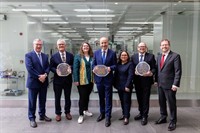
By 2030, Tyndall will significantly scale its economic and societal impact, growing annual income to over €80 million and expanding its workforce by more than 30% to over 750 employees. Tyndall 2030 strengthens commercialisation, with 10 new spinouts, and the scaling up of over 30 Irish SMEs by improving access to infrastructure, expertise, and global networks. The strategy, launched today by the Taoiseach at Tyndall National Institute, with James Lawless TD, the Minister for Further and Higher Education, Research, Innovation and Science also in attendance, marks a significant step forward in Ireland’s ambition to become a global leader in advanced technology, innovation and economic growth.
Semiconductors enable all forms of modern technology and are critical to everything from household appliances to medical devices, from AI agents to sustainable energy systems. As highlighted in Tyndall’s 2030 strategy, semiconductors are as fundamental to today’s world as electricity and water, enabling the development of advanced technologies and devices that have transformed many aspects of everyday life.
Tyndall National Institute, headquartered in Cork, is widely recognised as a European and global leader in semiconductor research and advancement. The Institute’s success is built upon the firm foundations of a partnership between University College Cork and the Irish Government, specifically the Department of Further and Higher Education, Research, Innovation and Science. Spanning the full technology value chain, from materials and device fabrication through to system-level applications, Tyndall plays a central role in Ireland’s semiconductor ecosystem. Powered by a diverse and highly skilled team, the institute is also a key driver of talent development, equipping the next generation to lead in one of the world’s most advanced and research-intensive industries.
With Tyndall 2030, the institute evolves from a centre of research excellence into a coordinated national platform, connecting ideas, academia, industry, and talent to deliver real-world impact at scale. The strategy includes the commitment to appoint 20 new Principal Scientists and 40 Senior Researchers, alongside the training of over 200 postgraduate students, ensuring a strong pipeline of future talent.
Speaking at the launch, the Taoiseach Micheál Martin said: “Tyndall 2030 demonstrates that Ireland knows where it wants to be and, crucially, how to get there. This strategy strengthens our global reputation as a hub for innovation, ensuring we continue to attract investment, develop talent, and lead in shaping the technologies of tomorrow.
Tyndall, along with Ireland’s national semiconductor strategy, Silicon Island, is ensuring that Ireland remains a global leader in the technologies that underpin everything from climate action to AI data centres.
This strategy confirms Ireland’s position in semiconductor innovation, both in Europe and globally. What we see here is not just world-class research, but a clear vision for the future, one that is powered by talented people, world-class infrastructure, and ambition."
Central to the strategy is a significant expansion of Ireland’s semiconductor capability, through increased infrastructure, investment in research programmes, and the development of future talent. The plan includes growth in postgraduate and postdoctoral research, alongside the rollout of a Future Leaders Programme designed to equip the next generation of innovators and industry leaders.
Minister for Further and Higher Education, Research, Innovation and Science, James Lawless TD, highlighted the broader national impact: “Tyndall 2030 sets out an ambitious vision to strengthen Ireland’s research and innovation capability in the critical technologies that will shape our future. Building advanced skills and deep expertise is central to this ambition and is a core priority of my Department. That commitment is being matched with action, including through the recently launched INSPIRE investment programme, which is transforming research infrastructure and talent across the higher education sector and represents a landmark investment in Ireland’s long-term competitiveness.
Tyndall’s success as a National Institute is rooted in strong partnerships and sustained strategic investment, and these same principles underpin the INSPIRE programme. Together, they will help drive Ireland’s economic resilience and global competitiveness, while delivering real progress on national priorities such as climate action, digitalisation, and health and wellbeing.”
Professor William Scanlon, CEO of Tyndall National Institute, said: “Tyndall 2030 is about translating world-class research into real-world impact. We are investing in both our people and our infrastructure to expand the footprint of Tyndall as a national asset, one that connects ideas, accelerates innovation, and delivers measurable economic value.
This strategy is about building the bridge from discovery to deployment, ensuring that the technologies developed here in Ireland reach global markets and make a meaningful difference.”
He added: “The future of Tyndall lies in both the people we develop and the technologies we create. Working together to power the next generation of semiconductor innovation for applications across healthcare, agriculture, climate, and digital industries.”
At its core, Tyndall 2030 is designed to translate innovation into tangible economic outcomes, supporting foreign direct investment, scaling indigenous SMEs, and enabling the creation of spinout companies. Tyndall’s success has been underpinned by a collaborative culture that removes traditional boundaries between disciplines, organisations, and sectors. This openness and connectivity has been critical in enabling the Institute to act as a catalyst for innovation.
By acting as a bridge between academia and industry, Tyndall 2030 strategy will accelerate the development of new technologies into real-world applications, helping companies grow, creating high-value jobs, and strengthening Ireland’s position as a global innovation hub.
Tyndall National Institute
-
Clara O'Mahoney Client Manager
- April 27, 2026
- Send Email
